
Checking Criminal History in Livingston County
The most useful starting point for Livingston County criminal court information is the Circuit Clerk's case-search route. Follow the official court directory to Online Records, or select Livingston County in Judici. A party-name search can locate an unknown case number; a full case number is more precise. Confirm the county, case type, filing year, and party before relying on a match. An Eleventh Judicial Circuit label also covers other counties, so it does not by itself prove the file is a Livingston County record.
Bring the full name, spelling variants, an approximate date, and the case or agency number if known. Then choose the record source by purpose. The docket gives the prosecution history, the creating police agency holds its report, the jail holds booking data, and Illinois State Police maintains state criminal-history information. These records overlap, but none replaces the others.
- Search the Livingston Circuit Clerk route by party name or case number.
- Match the county, year, case type, and filing date before opening a result.
- Read charge, event, disposition, and sentence entries as separate fields.
- Ask the correct police agency or jail for the related report or booking record.
- Order a certified disposition from the clerk or an official ISP response when proof is needed.
Four Livingston County Criminal Record Systems
A common search error is expecting one portal to contain the full Livingston County story. Police, jail, court, and ISP systems answer different questions. A police report records what officers observed and alleged. The Public Safety Complex creates a booking record when a person enters county custody. The Circuit Clerk opens the case only after charges are filed. ISP then compiles reportable state arrest and disposition information.
| Source | Best use | Key limit |
|---|---|---|
| Police or sheriff | Incident and arrest narrative | Does not establish the final outcome |
| County jail | Booking and current custody | No public Livingston inmate roster |
| Circuit Clerk | Filed charges, orders, and disposition | Not a statewide history |
| ISP | State repository response | Public CHIRP is conviction-focused |
Illinois Official Background Checks
The Illinois State Police Division of Justice Services, Bureau of Identification is the state repository. Its Criminal History Information Response Process, or CHIRP, supplies name-based public conviction information under the Uniform Conviction Information Act. An electronic inquiry costs $10, while the paper name inquiry costs $16. Each request covers one name; a maiden name or alias calls for a separate search.
A person reviewing their own Illinois history should use ISP Access and Review with fingerprints from a licensed live-scan vendor. ISP charges no Access and Review fee, though a fingerprint provider may charge for capture. A UCIA fingerprint inquiry costs $15 by live scan or $20 by paper card. The FBI Identity History Summary is the separate subject-only route for a federal record. None of these products is the same as a Livingston County docket.
| Official route | Method | Stated agency fee |
|---|---|---|
| CHIRP | Electronic name inquiry | $10 |
| UCIA paper | Manual name inquiry | $16 |
| UCIA fingerprint | Live scan or paper card | $15 or $20 |
| Access and Review | Fingerprint self-review | No ISP fee; vendor may charge |
Three Livingston County Records Buildings in Pontiac
Three Pontiac addresses mark different parts of the Livingston County records trail. The historic 1875 courthouse at 112 W. Madison Street is a county landmark and administrative address. The Law and Justice Center at 110 N. Main Street holds the Circuit Clerk's first-floor counter, courtrooms, probation, and prosecution offices. The Public Safety Complex at 844 W. Lincoln Street houses the Sheriff's Office, VCom dispatch, and the jail.
That close geography can hide a custody distinction. The State's Attorney prosecutes but is not the public docket custodian. Probation manages supervision but does not issue certified case copies. The County Clerk or Recorder is not the criminal clerk. Start with the Circuit Clerk for filed cases, the Sheriff for deputy reports and jail records, and the specific city police department for a city-created report.
The Illinois Courts directory shows the official Livingston County court location and public services.
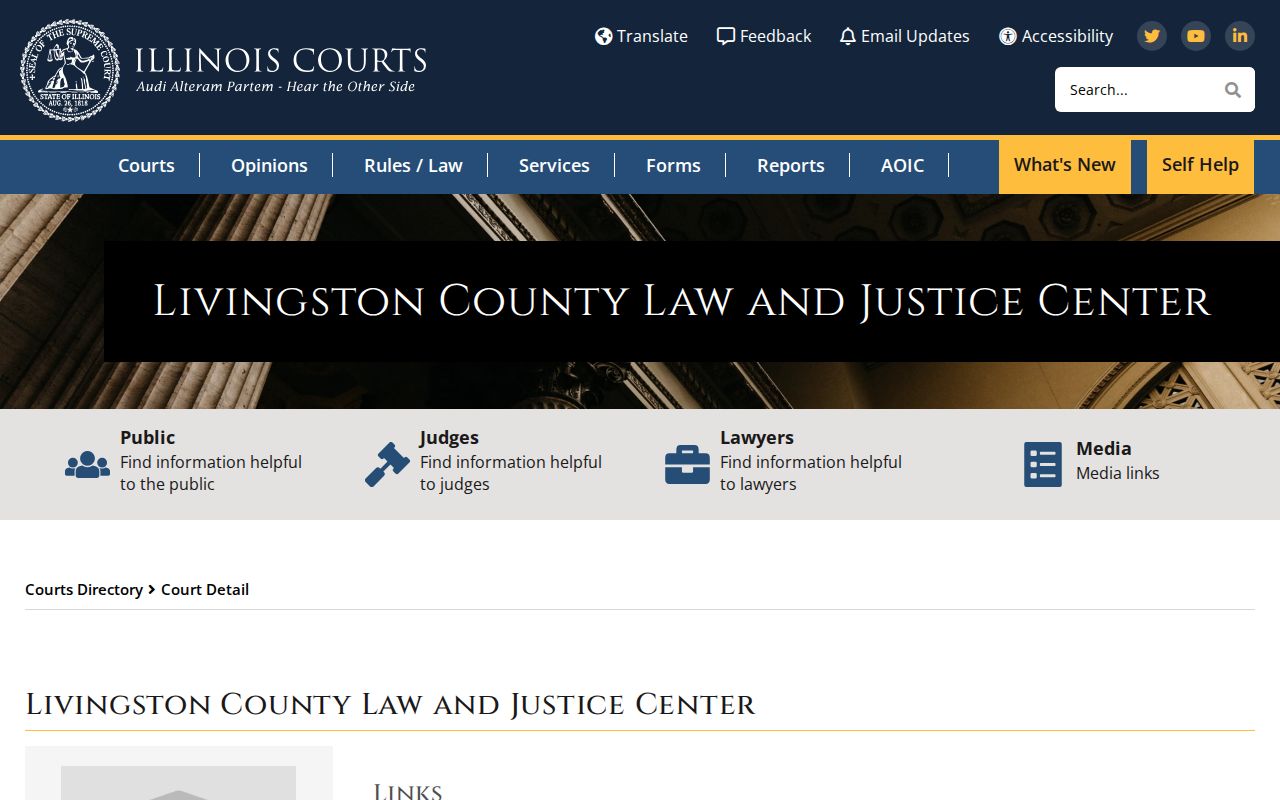
The directory confirms that court records and courthouse services center on the Law and Justice Center rather than the historic county building.
Circuit Clerk
110 N. Main St., Pontiac, IL 61764
(815) 844-2602
Weekdays, 8:00 a.m. to 4:30 p.m.
Sheriff and Jail
844 W. Lincoln St., Pontiac, IL 61764
Sheriff: (815) 844-2774
Jail: (815) 844-5774
Probation/Court Services
110 N. Main St., Pontiac, IL 61764
(815) 844-5177
probation@livingstoncountyil.gov
Criminal Record Types in Livingston County
Livingston County criminal records are grouped by the event and the office that created them. An incident report can exist without an arrest. A booking record can show an intake charge that later changes. The court file begins with filed charges and continues through hearings and judgment. State history depends on what agencies report to ISP. Warrants, corrections entries, supervision records, and registry profiles each have narrower functions.
- Arrest and booking records describe the agency action, intake, initial charges, custody, and release.
- Criminal court files contain charging papers, docket events, orders, disposition, and sentence.
- ISP history compiles reportable state events; the public UCIA response focuses on convictions.
- Warrant records arise from court and law-enforcement processes, but a docket entry may not show current service status.
- Supervision and registry records cover probation, IDOC release, or statutory public notification.
Livingston County Jail Has No Public Name Roster
Livingston County's 179-bed jail does not publish a current inmate-name roster or a 48-hour release log. For present county custody, call the jail at (815) 844-5774 or ask at the Public Safety Complex lobby. If phone staff cannot release the requested booking fields, submit a focused written FOIA request to the Sheriff. State-sentenced custody belongs in the IDOC Individuals in Custody search, while federal custody belongs in the Bureau of Prisons locator.
Illinois VINELink can supply custody-status notifications, but it does not certify a conviction or court result. A person may leave jail while the criminal case remains pending. For that reason, pair custody information with the Livingston Circuit Clerk docket. Do not use a wrong-state Livingston County sheriff site that appears in broad search results.
Inside a Livingston County Criminal Record
A Livingston County record must be read in context. Names and descriptive data help identify the subject, but a name match is not fingerprint confirmation. Arrest charges reflect the event at one point in time. Filed counts can differ, and a docket status such as disposed says only that the court reached an outcome. Read the judgment or certified disposition before calling the result a conviction.
| Name & Identifiers | Submitted names, aliases, descriptors, and agency or state identifiers. |
|---|---|
| Arrest / Booking Data | Event date, arresting agency, booking number, intake charge, custody, and release fields. |
| Charges & Statutes | Initial allegations or filed counts, statutory citations, and offense class when recorded. |
| Disposition | Dismissal, acquittal, supervision, plea, conviction, or another court outcome. |
| Sentence | Custody, probation, financial, or other terms entered by the court. |
| Custody / Supervision Status | County detention, IDOC commitment, probation, or mandatory supervised release information. |
When Livingston County Case Search Misses a File
A failed Judici search does not prove that no Livingston County case exists. Try the exact case number, alternate spellings, a narrower year, and the correct county selection. Very recent arrests can precede filing. Older cases may be paper, microfilm, or offsite. Sealed cases, juvenile matters, redactions, and identity mismatches also limit what appears online.
Call the Circuit Clerk at (815) 844-2602 with the case number, party name, approximate year, and document sought. Ask whether advance retrieval is needed and whether an uncertified or certified copy suits the purpose. The three first-floor kiosks are for e-filing; they do not mean every criminal document is a public image. The nearby law library and self-help center can help visitors navigate approved forms.
The Livingston County Circuit Clerk page illustrates the official local gateway used for court access.
That local office remains the source for the filed document or certified disposition when a portal summary is incomplete.
Public Access Laws in Illinois
Illinois access depends on both the record and its custodian. The Illinois Freedom of Information Act governs requests to executive public bodies, including police agencies, subject to exemptions. Court records also follow judicial access rules and clerk statutes. The Uniform Conviction Information Act makes ISP conviction information public, while the Criminal Identification Act governs state collection and record relief. A specific confidentiality law can override FOIA.
Key Statutes:
5 ILCS 140/3 sets the ordinary FOIA request and response framework.
5 ILCS 140/6 provides the copy-fee rules, including the first 50 black-and-white pages without charge.
20 ILCS 2635 governs public Illinois conviction information maintained by ISP.
20 ILCS 2630/5.2 defines and governs expungement and sealing.
730 ILCS 150 sets sex-offender registration duties.
Livingston County FOIA Requests by Custodian
Send a police-record request to the agency that created the report. Pontiac, Dwight, and Fairbury/Forrest keep their own city reports. Sheriff deputy reports and county booking records go to the Sheriff's Office. ISP District 6 records stay with ISP. A request should give the event date, location, agency case number if known, enough identifying detail to locate the event, and the exact report, audio, video, or log sought.
Ordinary noncommercial FOIA requests generally receive a response within five business days, with a permitted five-day extension for listed reasons and written notice. The first 50 black-and-white letter or legal pages are free; later pages may cost up to 15 cents each. Ask for an electronic copy and for nonexempt portions to be separated from material that must be withheld. A denial must state the exemption and review rights.
Current Livingston County Warrant Checks
There is no verified current public Livingston County warrant search and no statewide public Illinois warrant portal. The Sheriff's Wanted Persons page carries a March 2018 update date, so it cannot confirm whether a warrant remains active. A docket entry showing issuance can also be stale after service or recall, while a missing online entry may reflect lag, sealing, or an identity mismatch.
Use the Circuit Clerk or Judici for docketed warrant events, then confirm status through the Sheriff's Office at (815) 844-2774 or LivCom at (815) 844-0911. City-originating matters may also require the relevant police department. For a warrant in one's own case, contact the issuing court and qualified counsel about current procedure and surrender logistics. Illinois no longer uses the old cash-bail framework, so current release terms must come from the actual order.
Sealed, Expunged, and Restricted Records
Illinois uses both expungement and sealing. Expungement generally destroys or returns eligible records, while sealing limits ordinary public access without ending every government use. Eligibility under 20 ILCS 2630/5.2 depends on the charge, outcome, sentence, waiting period, and exclusions. Some dismissals and acquittals may qualify for expungement; many eligible convictions can only be sealed. Juvenile and victim information also has separate protection.
Use the Illinois Courts approved expungement and sealing forms and file in each circuit county where the record arose. A Livingston County request goes to the Circuit Clerk. Preserve a certified disposition first, list each arrest and case accurately, and allow time after an entered order for the clerk, ISP, and arresting agencies to update their systems.
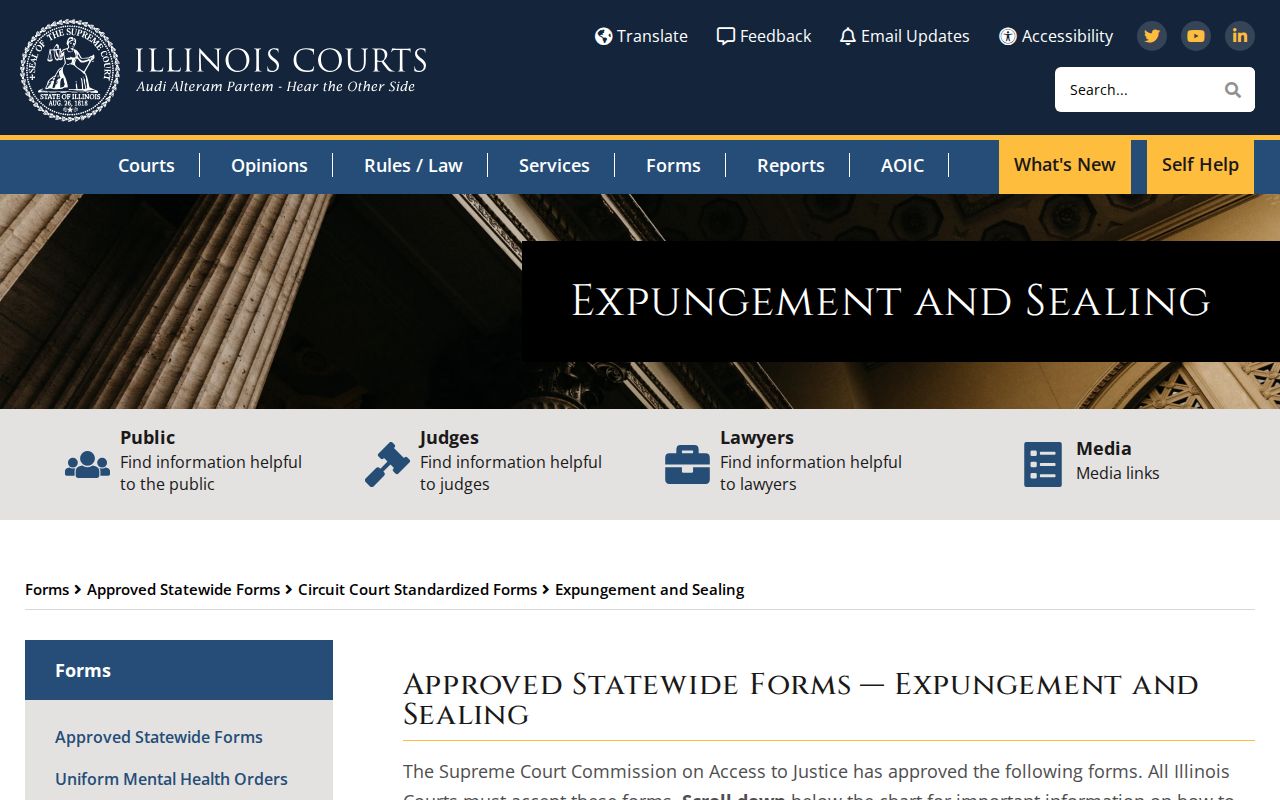
The approved form set includes the request, notice, order, and continuation pages needed when more than one arrest or case is involved.
Livingston County Probation Is Not a Public Database
Livingston County Probation and Court Services operates at 110 N. Main Street and handles adult and juvenile supervision, presentence work, transfers, community service, electronic monitoring, Drug Court, and Veterans Court. It is a county judicial department, distinct from IDOC parole and mandatory supervised release. There is no public Livingston probation-status database.
To verify a supervision term, read the circuit docket and sentencing order, request the order from the Circuit Clerk, and ask Probation only for information it may lawfully confirm. IDOC supervises people on mandatory supervised release, while the Illinois Prisoner Review Board performs its statutory release and revocation functions. VINE custody alerts are not the same as registration for a Prisoner Review Board hearing notice.
Livingston County Criminal Records by City
Pontiac, Dwight, and Fairbury are the three most populous incorporated places in Livingston County. Their police departments keep locally created reports, but criminal, traffic, and ordinance prosecutions flow to Livingston Circuit Court rather than separate city criminal-court portals. County detention routes to the jail in Pontiac. Each city page focuses on its own police contact and request process.
Pontiac Criminal Records
11,150 · City police reports, online FOIA, and county-seat record routing.
Dwight Criminal Records
4,032 · Police records clerk and Village Clerk FOIA channels.
Fairbury Criminal Records
3,633 · Fairbury/Forrest Police reports and written city FOIA requests.
Correcting a Livingston County Criminal History
If a dismissal is missing or an entry looks wrong, begin with the underlying record. Obtain the Livingston County docket and, when needed, a certified disposition from the Circuit Clerk. Compare it with an ISP Access and Review response for your own state history. Identify the exact arrest cycle, charge, disposition, and agency that submitted the disputed data.
The originating police agency or court may need to correct its source before ISP can update the repository. Keep the fingerprint transaction or control information supplied through Access and Review. Name-based CHIRP searches can also produce false matches, so a similar name should not be treated as proof of identity. Sealing or expungement is a separate legal remedy, not the same process as correcting a reporting error.